Mostrando entradas con la etiqueta Antifascismo. Mostrar todas las entradas
sábado, 7 de noviembre de 2020
Agente Provokador #26, Programa Independiente.
https://www.youtube.com/watch?v=qBzSYrCoxTc&feature=youtu.be&fbclid=IwAR2Zphdff9RpDdy7YO9pd9WzyWqvpFE7Ejau4l5wXq13mgOto72Us9u9a3I
Ya podes escuchar en directo el Programa Independiente número 26 de AGENTE PROVOKADOR.
Un episodio que Leo Peirano y yo te ofrecemos desde las plataformas LBRY y "Yutuv" entre otras. Hoy musicalizamos el programa con bandas Punks y #Punk Hardcore mayoritariamente sin olvidar las raices del #Reggae.
Por otro lado te adelantamos que en nuestros articulos de hoy hablaremos acerca del Ecofascismo, como surge, quien lo inventó, y algunos ejemplos para que puedas distinguir este pequeño y casi invisible grupo pero que tiene bastantes seguidores en el mundo, y del cual tendrias que tener identificado para no darle cabida.
Tambien hablaremos acerca de #guyfawkes quien cada 5 de Noviembre es recordado debido a un intento frustrado de atentado en gran Bretaña y que deberias escuchar para entender el porqué de la máscara de Anonymous. Gracias Niko Perez por compartir este articulo!
Cerramos con un relatos de aquel boicot de la banda #CRASS hacia Margaret Tatcher en 1982.
Los doblajes de Alfredo Diaz, más relatos, y la música de fondo de la banda Surf #thekilaueas darán más forma, a una más que recomendable hora de entretenimiento lleno de curiosidades.
De mas está agradecerles a quienes comparten siempre nuestros links para hacernos llegar a mas público, a quienes se suscriben, a quienes se ofrecen o aceptan ser Selectores musicales en nuestros episodios, y por sobretodas las cosas, a quienes nos escuchan!!
- #ManolokabezaBolo y los que no dan pie con bolo
- #Antinowereleague
- #KlasseKriminale
- #FuneralDress
- #BurningHeads
- #TheErections
- #Gism
- #Tragedy
- #LaMemoria
Ahora si, AMA LA MUSICA, ODIA EL FASCISMO!!!
jueves, 23 de marzo de 2017
A History of Anti-Fascist Punk Around the World in 9 Songs
In
its four decades, punk has meant many different things to many
different people. Its relationship to fascism, the specter of which has
stopped rattling its chains from history books and re-appeared in the
West, is one of the most complicated examples of how aesthetics and
philosophy can appeal to both anti-authoritarian and deeply repressive
positions. You can find it in punk’s beginnings, as a reaction to
the cultural forces of generations prior, the long shadow of World War
II among them. Ron Asheton of the Stooges collected and wore Nazi
memorabilia to signify his bond with his father, a former Marine Corps
pilot. Sid Vicious’ swastika was a fuck-you to his parents’ generation,
and largely orchestrated by the (Jewish) Malcolm McLaren. And the electric eels just wanted to piss everyone off equally.
Look no further than the formation of Rock Against Racism
(RAR) for a sub-story that contextualizes just how thin the line can be
when it comes to manipulating fascist symbolism. In response to a
growing National Front presence in England during the mid-’70s, RAR
united rock and reggae subcultures (and more importantly, black and
white folks). The organization was closely affiliated with the Anti-Nazi League, a public effort of the Trotskyist Socialist Workers Party; the strict party line embedded in its core philosophy felt suffocating to some. In the case of peace-punk band Crisis,
a RAR favorite, bassist Tony Wakeford (who had been a Socialist Workers
Party member) and guitarist Douglas Pearce (who had been involved with
the International Marxist Group)
began to feel so alienated that they formally split from RAR. Wakeford
and Pearce went on to form neofolk group Death in June, which began its
career playing with the aesthetics of paramilitary fascism (Nazism in
particular) as satire—stances that became much muddier from there.
Wakeford got the boot from the group in 1984 for his relationship at
that time with the National Front, which lasted less than a year; these
days, for his part, he is publicly critical of the far right. But Pearce, who keeps Death in June active still, continues to court controversy.
Similarly, the splintering of
both the UK and U.S. labor movements, under pressure from Thatcher and
Reagan during their tenures, brought about both racist skinheads and skinheads who reacted by speaking out against racism.
All this ongoing friction and subsequent reaction, embedded in punk’s
formation and carried through along multiple veins to the present, has
also created some of the best and most relevant music to directly
critique fascism in its many iterations. Here, we present just a few,
shying away from many of the more obvious and well-known choices here
(Dead Kennedys’ “Nazi Punks Fuck Off,” Oi Polloi’s “Bash the Fash,” etc.)
Johannesburg, South Africa, 1977: National Wake, “International News”
Following the 1976 Soweto uprising,
in which students protesting apartheid were murdered by state police,
Ivan Kadey and brothers Gary and Punka Khoza did what countless others
have done when feeling helpless and frustrated, in need of a voice: they
started a punk band. They mixed Stooges-esque garage, the repurposed
disco structures and acerbic political analysis of bands like the Pop
Group and Gang of Four, two-tone ska, reggae, and African polyrhythms
into one heady setlist. But more on the rowdy and raw hard-rock end of
things, “International News” took aim at the role of the international
media in perpetuating both apartheid and the atrocities of the Angolan War of Independence
with sensationalistic reporting. Unsurprisingly, National Wake found
themselves the subject of state police surveillance and censorship,
making it difficult to secure spaces to play. The pressure eventually
split the band apart, but they hadn’t been forgotten; preserved through
tape trading and Kadey’s own record-keeping, their recorded material is
now available in its original, uncensored condition thanks to Light in the Attic.
Belgium, 1977: Basta, “Abortus Vrij de Vrouw Beslist!”
Those who have never had their
reproductive systems regulated by the government may wonder why a song
about abortion rights appears on a list of anti-fascist punk songs;
those who know the danger of electing Mike “Burial or Cremation for
Aborted and Miscarried Fetuses” Pence to one of the highest offices in
the land may not. This 7-inch was Basta’s only release, and one of the
first Belgian punk releases of any sort. Beyond this significance, the
song is incredibly catchy, with a saxophone line reminiscent of Lora
Logic’s dissonant contributions to X-Ray Spex and Essential Logic, and a
shouted chorus that was a common phrase at pro-choice protests (essentially meaning, “yes, abortion for women!”).
Belgium was actually one of the last countries to legalize abortion
(not until 1990!), which made Basta’s urgent-sounding record even more
significant: the sleeve listed clinics where abortions could safely be
obtained.
Rotterdam, Netherlands, 1978: The Rondos, “Which Side Will You Be On?”
The Rondos were Maoist punks, leftist militants who provoked everyone from the Dutch Communist CPN party to (closed-mindedly) Rastafarian culture to Crass, who held the Rondos at least partially responsible for the violence that often characterized Crass shows starting in 1979 (when the two bands played together) onward. From the Rondos’ own biography:
“Were we really communists? We assented to it half mockingly and half
seriously. In the beginning, our lyrics were non-political or generally
‘anti.’ Wayward, anyhow. Over time we became more serious about our
communist image. More fanatical too, due to pressure from the outside.”
They had their own magazine (Raket, or Rocket) and alternative bookshop (Raketbase), a hub for the early Dutch punk scene. “Which Side Will You Be On?” was an urgent pogo and a call to action to do something, rather than sitting around talking endlessly about strategy. One cannot, after all, fight fascism by words alone.
Austin, Texas, 1980: The Dicks, “The Dicks Hate the Police”
A blatantly Communist band fronted by an unapologetic fat gay man in Texas
released their first single, in which said singer barked in the voice
of a violent cop hell-bent on abusing his power against the
marginalized... to impress his parents. The song contained few words and
fewer chords, and yet, with an arch sneer, the singer—Gary Floyd, a
genuine punk hero deserving of recognition beyond the
underground—communicated the essence of state power deployed in its most
wretched everyday form. “The Dicks Hate the Police” is, at least to
this writer, one of the greatest songs of all time, punk or not.
Innumerable covers—chief among them Mudhoney’s most famous one—support this theory.
Essex, England, 1980: Poison Girls, “Bully Boys”
Over 40 and differing from the
traditionally attractive frontwoman archetype, Jewish refugee Vi
Subversa found herself beloved by Crass and friends upon starting up her
first punk band. Inspired by the wryness and hookiness of the
Buzzcocks, Subversa brought a delicate balance of thoughtful
consideration and pummeling ferocity to the burgeoning peace-punk
movement. Her history of real-world activism also helped to accomplish
some actual work against nuclear disarmament, among other causes. “Bully
Boys” was a remarkably catchy little ditty, all buzzsaw guitars,
throaty vocals, and punchy drums in service of implicating the role of
machismo in National Front violence. The band said
that the track, along with “The Bremen Song” (about the Holocaust), led
to racist skinheads attacking them at gigs and at home. Subversa’s
lyrics were less “the personal is political” in the sense of isolating
her experiences as being characteristic of grander political trends, and
more “the political is personal,” focusing on how political systems
manifest themselves in everyday life.
East Berlin, 1983: Namenlos, “Nazis Wieder in Ostberlin”
It’s unsurprising that East
Germans struggling through the stultified economic conditions of the
state-controlled Soviet German Democratic Republic found the crudest
impulses of anti-authoritarianism in punk aesthetics to be an effective
way of voicing their protest—and that the government responded to them
as a direct threat. State harassment, police beatings, and apartment
raids were regular parts of punk life, forcing many street kids into
churches for sanctuary, where they became politicized, mixing with
varying civil rights and environmental activist groups who also needed
that protected space to meet. Namenlos were among this newly,
ferociously politicized breed, employing wiry rock’n’roll riffage and
direct lyrics with appropriate seriousness given their environment. The
government doubled down on state repression rather than loosening it,
and “Nazis Wieder in Ostberlin” (“Nazis Again in East Berlin”) landed
three members of Namenlos behind bars. They were held in jail for six
months without full charges while being interrogated, and were
eventually sentenced to 18 additional months in Stasi prison for their
“anti-government lyrics.” Even public support for Namenlos could land punks in jail
for months on end. And yet the fire started by mixing disenfranchised
street kids and politically savvy strategists couldn’t be extinguished
once it’d been set: an organized youth protest movement, punks included,
was no small part of the political rebellion that eventually toppled
the Berlin Wall.
San Pedro, California, 1984: Minutemen, “Political Song for Michael Jackson to Sing”
So dig this big crux: Think
of Mike Watt and D. Boon as the blue-collar socialist punk versions of
Bert and Ernie. Friends since age 13, the duo’s oscillating heartbeat is
what makes Minutemen so beloved and still relevant today. While the
lyrics to this avant-garde punk classic are the least didactic on this
list, they are no less direct than any others, and no less evocative
(“Me, naked with textbook poems spout fountain against the Nazis”). How do
we assert our politics through song, Boon asks, making sincerity a
strength rather than a weakness. A crucial question for anyone who’s
ever made an impassioned argument and thought, “I must look like a dork”—particularly at a time when neo-Nazis rely on chaotic disdain for anyone who cares too much as provocation meant to disarm.
Santiago, Chile, 1984: Los Pinochet Boys, “La Música del General/Esto Es Pinochet Boys”
At the most repressive point of the Pinochet dictatorship,
Daniel Puente Encina formed an explicitly anti-fascist punk band with
his friends and called it Pinochet Boys. Their first single? “Music of
the General.” This was not the kind of punk danger most Americans are
familiar with; it was not even a Green Room-type scenario. This was treason against a fascist state.
With every show a secret, risking shut-down by military police,
Pinochet Boys gigs were places for young, emerging activists to meet and
strategize. The youth movement would become a crucial part of the
revolution that led to the Chilean national plebiscite in 1988,
a referendum that finally forced the Pinochet regime from power and
paved the road for democracy. “This machine kills fascists,”
indeed—though Encina and the other Boys were exiled in 1987. From a
purely musical standpoint, the song was half classic sing-along
punk-band-name-as-anthem and half bizarre, zippy new wave outer-space
transmission, one of the weirdest and coolest earworms around. Even if
it hadn’t played a historically documented and practical part in actually bringing down a 16-year dictatorship, it’d be worthy of inclusion here.
Mexico City, 1990: Massacre 68, “Sistema Podrido”
Named for those murdered in 1968 while peacefully protesting the repressive Díaz Ordaz government (as part of the Mexican Dirty War),
Massacre 68 were fairly straightforward thrashers with lyrics bluntly
critical of the government corruption and state violence surrounding
them. In 1988, a rigged election declared
the Institutional Revolutionary Party the new ruling party, though with
phenomenally low voter turnout due to a “crashed” system—a cover that
was later revealed to have been the result of corruption and burned
ballots. Massacre 68 directly critiqued this election in “Sistema
Podrido” (“Rotten System”), off their first LP, 1990’s No Estamos Conformes.
These are perhaps the most ripping solos committed to a record about
horrendously corrupt voter fraud. But stateside listeners didn’t get hip
to Massacre 68 until L.A. label Huarache Records re-released their
material in the early 2000s, right around the time documents were
finally revealed detailing the Mexican government’s role in both the ’68
murders and the ’88 election fraud.
La unica protesta anti-fascista durante la ocupacion nazi en Europa.
On this day in 1941: anti-Nazi February strike in Holland
- February 25, 2016
The famous February
strike of 1941 was the only major protest in solidarity with Jews in
Europe during the Nazi era, and has since been a symbol of resistance.
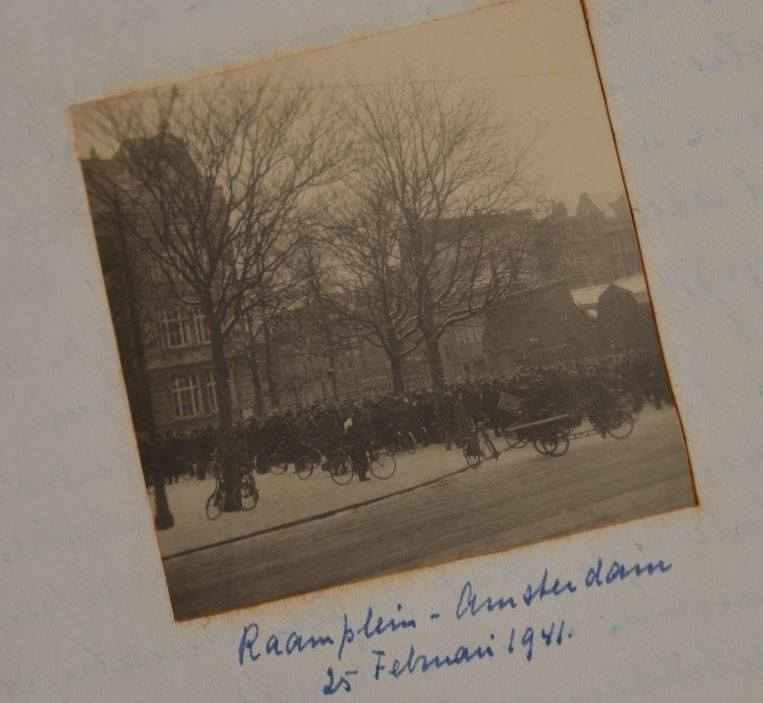
Day of AmsterdamOn February 25, 1941, workers in Amsterdam went on a two-day general strike against the Nazi persecution of Jews.
Whatever one may forget from these bitter times;
Never this exceptional day.
When the people, threats and dead facing,
For the sake of justice,
Rose up for the people that lay under.
— presumed to be written by Mr. Sem Davids, translated from Dutch by Jelle Bruinsma
The months preceding the strike had been tense, with Dutch Nazi organizations harassing Jews in the Jewish neighborhood. In response Jews (and non-Jewish supporters) formed self-defense groups, resulting in a series of street battles, in which one Dutch Nazi died. The Germans then sealed off the Jewish neighborhood for non-Jews.
A week later, on February 19, a massive fight broke out in the Jewish ice-cream parlor Koco after the Grüne Polizei tried to enter but was confronted with a self-defense unit from the neighborhood, injuring several officers. In revenge, the Nazi’s staged a large-scale pogrom a few days later in which 427 Jewish men between age 20 and 35 were arrested and deported, most of whom died in Mauthausen concentration camp.
Although the role of the Dutch Communist Party is downplayed in official commemorations, its role was instrumental. Taking their lead from the strike in the metal industry weeks earlier (which successfully blocked the deportation of metal workers to German factories), the communists called out and organized for a general strike on February 24 in the hope that this would show the German occupier that persecution of Jews would be too costly in the Netherlands and would work against their local allies (the NSB).
On the morning of February 25, public transport workers were the first to strike, while communists were spreading the strike manifesto across work places in town. By noon the strike had paralyzed the entire city, and soon spread to the surrounding regions, from Zaandam to Utrecht.
After two days of brutal repression – in which nine strikers were killed, dozens others severely injured, and many more imprisoned – the Nazi’s succeeded in suppressing the strike. Several strike leaders were later executed by firing squat.
Although ultimately unsuccessful, the Amsterdam February strike will forever have its place in the history of antifascist resistance, and the brave men and women who risked their lives will forever be remembered for their bravery and solidarity with their persecuted fellow citizens.
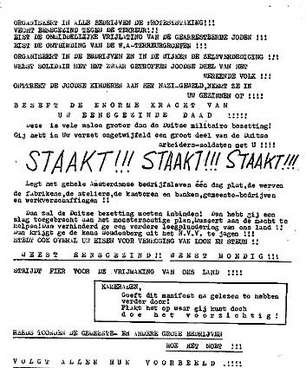
Some key passages from their strike poster sadly echo strikingly relevant in today’s Europe:
Protest against the horrible persecutions of the Jews! During the recent Saturday, Sunday, and Monday the Nazis behaved like beasts in neighborhoods with Jewish inhabitants.
Hundreds of fully armed members of the military police suddenly appeared in the old city and in other neighborhoods and attacked helpless men, women, and children, while yelling, shouting, cursing, and shooting.
Hundreds of Jewish youngsters were seized in the streets, thrown into police cars, and sent to an unknown place of horrors.
This is the Nazi revenge for the brave self-defense that, two weeks ago, caused two Nazi riot “heroes” to retreat and the killing as a terrorist of the Fascist bandit Koot.
This is the ugly answer to the anger of the masses and the massive protest demonstration of the citizens of Amsterdam against the pogrom carried out against the Jews.
That is mainly the result of the great-capitalist “mediation” of Asscher, [Rabbi] Sarlovis, and Cohen, who, in their servility, agreed to shoulder the Jews’ guilt and attempted to defeat the continued adoption of defensive measures in the struggle, arguing that “calm” will now be restored. These great capitalists are afraid that a ransom will be imposed, and their money is dearer to them than the Jewish workers!
The SS and the military police, whom even the German soldiers loathe, are carrying out this dirty work with genuine pleasure. Here the dregs and the chaff of the German people are at work. The stupid and lowly Dutch Nazis, the dregs of our people, who absented themselves in this case, should learn from this rabble how to impose terror on the working masses.
These riots against the Jews represent an attack on all the laboring masses!!!
They constitute the beginning of harsher enslavement and terrorism!!!
They cannot but pave the way for the usurpation of rule by Mussert, whom every Dutchman despises!!!
Proletarian residents of Amsterdam, will you put up with this?
No, a thousand times no!!!
Are you able and willing to prevent this disgusting terror in the future?
Yes, definitely!!!
The metalworkers in Amsterdam have shown the way. They struck in unison against their forced transport to Germany, and the coercive power of the German military administration had to contend with this resistance! In one day, the metalworkers triumphed!!
So, do not let the jackboot of the German soldier intimidate you!
Organize protest strikes in all factories!!
Join ranks to fight against this terrorism!!
Demand the immediate liberation of the interned Jews!!
Demand the disbanding of the Dutch Fascist terror groups!!!
Organize self-defense in factories and neighborhoods!!
Show your solidarity with the Jewish segment of the proletariat, which has been so badly mistreated!!
Spare the Jewish children from the terror of the Nazi atrocities; take them in with your families!!!
Be aware of the tremendous might of your unified action!!!
It is much greater than that of the German military occupation! There’s no doubt that many German proletarian soldiers support your resistance!!!
Strike!! Strike!! Strike!!!
Shut down all of Amsterdam for one day—shipyards, factories, shops, offices, banks, city hall, and enterprise works!!
Then the German occupier will have to retreat! You will have dealt a blow to the monstrous scheme to bring Mussert to power! You will have thwarted the continued plunder of our land!
You will have made it possible to oust Woudenberg from the trade union!!!
Demand increases in wage and welfare benefits everywhere!!
Be united!! Be brave!!
Stiffen your spine and fight to liberate our country!!!!
Fuente: Roarmag.org
Suscribirse a:
Comentarios (Atom)